YBT YardBuild Tools Landscaping · Aggregate · Framing tools
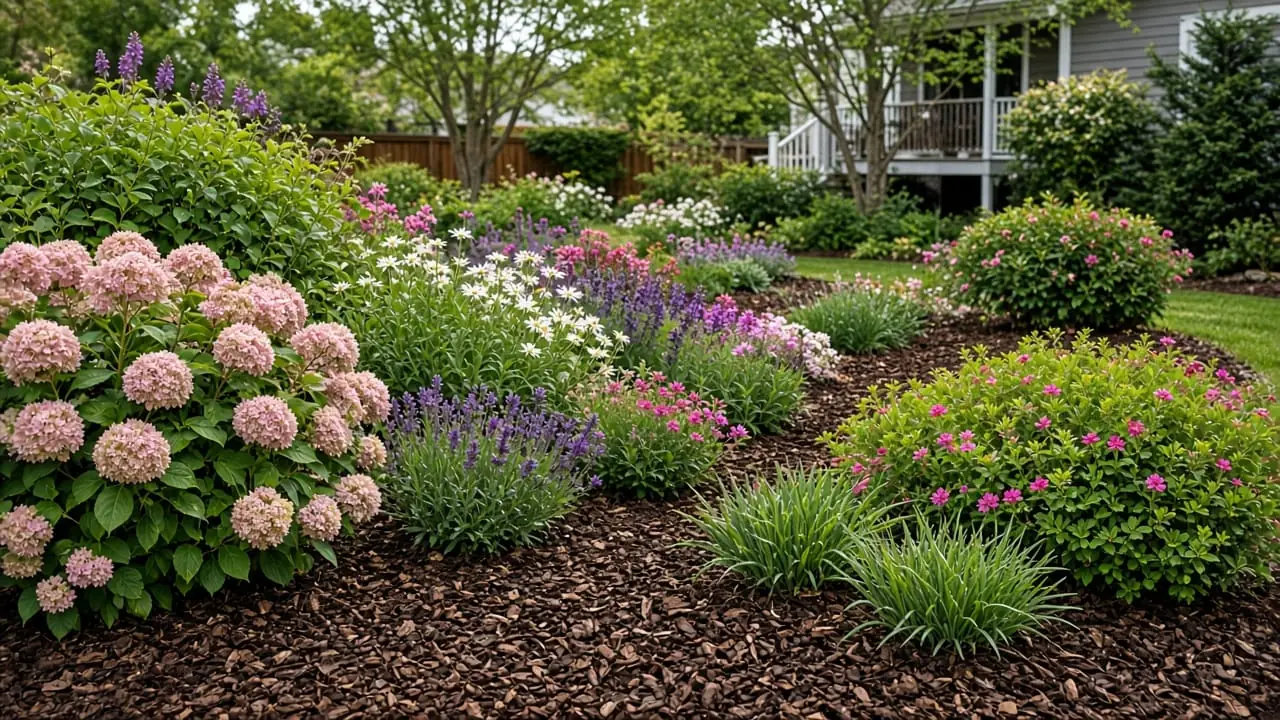
Flower beds with bark mulch in a suburban backyard

Yard · Landscaping

Mulch calculator

Figure mulch yards or bags from bed size, target depth, and already-down / existing depth (buy-depth = target − existing).

What this calculates

Buy-depth volume (target − already down), fresh-bed comparison, waste%, bag counts, optional bags↔bulk cost ledger from your prices, multi-bed area, coverage table, and pickup trips.

Show

Buy-depth volume (target − already down), fresh-bed comparison, waste%, bag counts, optional bags↔bulk cost ledger from your prices, multi-bed area, coverage table, and pickup trips.

Does not replace

  • Plant-specific horticultural prescriptions for every species
  • Soil testing or drainage design
  • Permission to pile mulch against trunks (extensions advise against this)

Supply yard

Materials you’ll need

Full materials catalog →

Recommended starting values

Starting points for planning — not a site-specific design. Footnotes point to sources on this page.

Topic Typical starting value Source notes
Established landscape beds 2–3 inches settled depth Oklahoma State Extension; UF/IFAS Florida-Friendly Landscaping Principle 4; Penn State fruit-planting mulch guide.
Fine vs coarse texture Fine ~2 in; coarse ~3 in (OSU) Oklahoma State University Extension fact sheet.
Seedlings / small herbs Often ≤ 1 inch UF/IFAS ENH1361/EP625 — avoid smothering small plants.
Clearance at trunks Leave inches to ~1 ft clear depending on plant size UF/IFAS & Illinois Extension — no volcano mulching.
Illinois tree rings (broader range) About 2–4 in depending on material University of Illinois Extension proper mulching infosheet.

Case studies

Short DIY narratives. Numbers match the one-click scenario presets in the calculator (US units).

Landscape bed 20×8 @ 3″

Problem
New front-bed mulch after weeding in early spring.
Inputs
20×8 ft × 3 in, 5% waste, 2 ft³ bags
Outputs
40 ft³ ≈ 1.48 yd³ → ~1.56 yd³ with waste → 21 bags of 2 ft³.
What to order / next step
Compare bulk yard price vs 21 bags. Keep mulch off shrub stems.

Raised bed 12×4 @ 3″

Problem
Top-dress paths inside a raised vegetable frame (not filling the soil volume).
Inputs
12×4 ft × 3 in, 5% waste
Outputs
Scenario chip fills the calculator — check bag vs bulk for this smaller volume.
What to order / next step
For edibles, prefer clean/untreated mulch materials recommended by local extension.

Refresh strip 30×3 @ 2″ (1″ already down)

Problem
Top up a thin border that weathered over summer.
Inputs
30×3 ft, target 2 in, already down 1 in, 5% waste, 2 ft³ bags
Outputs
Buy-depth 1 in → 7.5 ft³ ≈ 0.28 yd³ → ~0.29 yd³ with waste → 4 bags. Fresh-bed at 2 in would be ~0.58 yd³.
What to order / next step
Rake existing mulch first; order the buy-depth figure, not a full rebuild.

100 sq ft bed @ 3″ — bags vs bulk call script

Problem
Small front bed; deciding HD bags vs nursery bulk delivery.
Inputs
100 sq ft × 3 in, 5% waste, 2 ft³ bags
Outputs
25 ft³ ≈ 0.93 yd³ → ~0.97 yd³ with waste → 14 bags of 2 ft³.
What to order / next step
Call script: “About 1 cubic yard (or 14×2 ft³ bags) for a 100 sq ft bed at 3 inches.” Bags often win under ~⅓ yd with no delivery minimum; enter your $/bag and $/yd to compare.

How much mulch for my bed?

Measure each bed as a rectangle (or split odd shapes). Use 2″ refresh or 3″ new-bed presets when following extension practice. Deeper is not always better — Illinois Extension notes thick mats can reduce oxygen and water movement.

Bags vs bulk

Bags are easy for small borders. Once you pass roughly a third of a cubic yard, compare the yard’s bulk price per cubic foot — bulk usually wins for full front beds. This calculator shows both so you can decide before the weekend rush. Prefer a dedicated landing with the ledger emphasized? See bags vs bulk mulch.

How we calculate

Same volume base as gravel: ft³ = L × W × D (in feet). Yards = ft³ ÷ 27. Bags = ceil(waste-adjusted ft³ ÷ bag size). Waste factor = 1 + waste%/100.

Worked example (20×8 @ 3″)

20 × 8 × 0.25 = 40 ft³ ≈ 1.48 yd³. With 5% waste → 1.56 yd³ or 21 bags of 2 ft³.

FAQ

How much mulch do I need if some is already down?

Enter target depth and “Already down” (existing thickness). The main result is buy-depth = target − existing (floored at 0), then yards/bags with waste. Fresh-bed volume stays visible for comparison. Extensions commonly recommend about 2–3 inches settled for landscape beds. Optional bag/bulk prices you enter drive the cheaper verdict — we do not publish national reference prices.

How much mulch do I need?

Measure each bed (or enter total sq ft / named beds). Set target depth and already-down thickness so you order buy-depth, not a full rebuild. Extensions commonly recommend about 2–3 inches settled for landscape beds.

Bags vs bulk mulch?

Compare price per cubic foot. Bulk usually wins above roughly ⅓ cubic yard. Bags are convenient for small refresh strips; large front beds are almost always cheaper as bulk yards.

How thick should mulch be?

Multiple U.S. university extensions recommend about 2–3 inches for typical landscape beds. Keep mulch off trunks — volcano piles against bark are discouraged.

What is volcano mulching?

Piling mulch against the trunk. Extensions warn it traps moisture and can promote rot and pests — pull mulch back.

Sources & references

We cite extension services, manufacturer guidance, and municipal/IRC reprints. This is not legal advice, not a substitute for a licensed engineer or architect, and not approval from your Authority Having Jurisdiction (AHJ). Adopted codes and product warranties vary by place and year — verify before you buy or cut.

  1. All You Need To Know About Mulch — Oklahoma State University Extension

    Extension guidance: mulch 2–3 in near plants; coarse ~3 in, fine ~2 in; avoid mounding against trunks.

  2. Mulching Herbs, Vegetables and Fruit Trees (ENH1361/EP625) — University of Florida IFAS Extension

    Apply 2–3 in around established plants; seedlings/herbs often ≤1 in; leave space at trunks (no volcano mulching).

  3. Principle 4 — Mulch (Florida-Friendly Landscaping) — University of Florida IFAS

    Keep a 2–3 in layer on plant beds; leave space around trunks.

  4. Proper Mulching Techniques — University of Illinois Extension

    Recommends roughly 2–4 in depending on material; keep mulch off trunks.

  5. Applying Mulches in Home Fruit Plantings — Penn State Extension

    Settled mulch depth typically 2–3 in for weed control and moisture; keep away from stems.

Full site bibliography: Sources hub.

Related calculators