YBT YardBuild Tools Landscaping · Aggregate · Framing tools
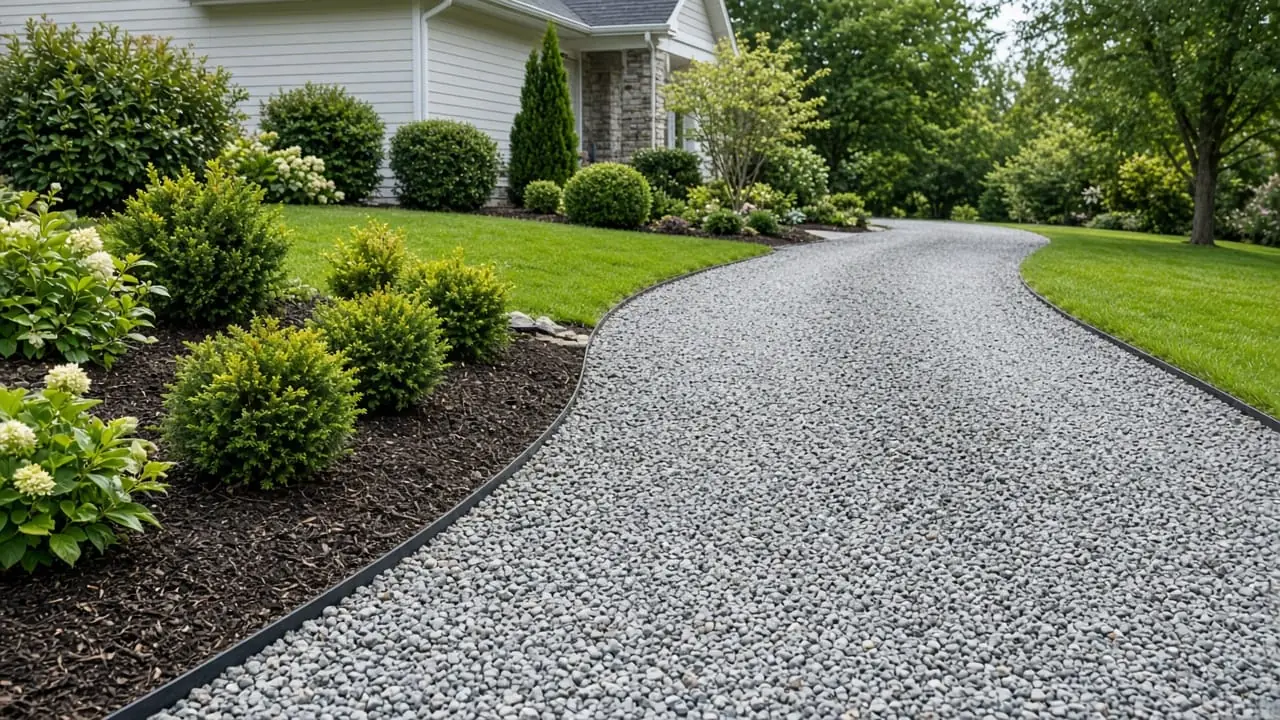
Finished crushed-stone gravel driveway in a suburban yard

Yard · Aggregate

Gravel calculator

Estimate gravel volume in cubic yards, tons, or bags for paths and pads.

What this calculates

Coverage volume (rectangle or total sq ft), overage vs optional compaction allowance, tons from an inline density table, bag counts, optional material cost from your $/yd or $/ton, and payload trips.

Show

Coverage volume (rectangle or total sq ft), overage vs optional compaction allowance, tons from an inline density table, bag counts, optional material cost from your $/yd or $/ton, and payload trips.

Does not replace

  • A stamped pavement or geotech design
  • Subgrade evaluation, geotextile selection, or drainage design
  • Guaranteed compaction % (DOT 95% targets need field testing)

Supply yard

Materials you’ll need

Full materials catalog →

Recommended starting values

Starting points for planning — not a site-specific design. Footnotes point to sources on this page.

Topic Typical starting value Source notes
Decorative / path surface course About 2–4 in compacted surface stone over a prepared base Common DIY practice; confirm with your supplier. Not an NRCS thickness recipe.
Driving-surface aggregate example ~8 in loose → ~6 in compacted (municipal DSA context) Penn State Dirt & Gravel Road Studies, DSA Handbook Appendix G — road context, adapt cautiously.
Aggregate base lift thickness (highway practice) Compacted lifts often ≤ 6 in unless approved otherwise CDOT Standard Specs §304 — illustrates lift discipline, not a home recipe.
Waste / overage for DIY ordering Often start around 10% Rule of thumb for edges/settling — not a lab density factor. Ask the yard.
Density (crushed stone planning) ~1.3–1.5 ton/yd³ depending on product & moisture Supplier ticket / scale. Presets are planning aids only.

Case studies

Short DIY narratives. Numbers match the one-click scenario presets in the calculator (US units).

Garden path 20×10 @ 4″

Problem
Replace muddy side-yard path with crushed stone before spring plantings.
Inputs
20 ft × 10 ft × 4 in, 10% waste, density 1.4 ton/yd³
Outputs
~2.47 yd³ raw → ~2.72 yd³ with waste → ~3.80 ton; bags would be ~147 × 0.5 ft³ (impractical).
What to order / next step
Call for ~2.75–3.0 yd³ or ~4 ton crushed stone bulk. Compact base separately if the path sees carts.

Single-car pad surface 20×10 @ 6″

Problem
Refresh the top course on an existing compacted pad (not building the full structural section).
Inputs
20×10 ft × 6 in, 10% waste, crusher-run density 1.5
Outputs
Volume and tonnage scale with the deeper course — use the scenario chip, then verify with the yard.
What to order / next step
Order by the ton if the yard weighs trucks. Full driveway rebuilds need base + subbase beyond this surface volume.

Shed pad 12×12 @ 4″

Problem
Level pad under a small storage shed.
Inputs
12×12 ft × 4 in, 10% waste, 1.4 ton/yd³
Outputs
Smaller rectangle — still usually cheaper as bulk than bags.
What to order / next step
Confirm shed manufacturer pad requirements; this calculator only covers the aggregate volume you enter.

12×50 driveway surface @ 4″ (#57)

Problem
Refresh the driving surface on a single-car gravel drive (not rebuilding the full base).
Inputs
12×50 ft × 4 in, 10% overage, density 1.4 ton/yd³ (#57)
Outputs
200 sq ft × 0.333 ft = 66.7 ft³ ≈ 2.47 yd³ → ~2.72 yd³ with overage → ~3.80 ton.
What to order / next step
Call script: “About 2.75 cubic yards / ~4 tons of #57 for a 12×50 surface at 4 inches with 10% overage.” Confirm whether the yard sells by the ton.

How much gravel do I need?

Forum and yard questions usually start the same way: measure the rectangle, pick a depth, convert to cubic yards, then decide whether the supplier sells by the yard or the ton. Enter length and width in feet (or meters) and depth in inches (or centimeters). Paths often sit around 2–4 inches of surface stone; structural bases run thicker and should follow local practice or an engineered section. Scene guides: pea gravel patio · driveway gravel depth.

Yards vs tons, bags vs bulk

Cubic yards measure volume. Tons measure weight and need a density (ton/yd³) from your yard’s ticket — moisture and product grade change the number. Bags are fine for patches; bulk wins once the job is larger than a few dozen bags. This tool shows all three so you can compare before you call.

NRCS’s aggregate surfacing guide calculates thickness from load, subgrade strength, and aggregate quality — there is no single residential driveway depth that applies everywhere. Highway specs (for example CDOT §304) emphasize placing aggregate in lifts and compacting each lift; DIY projects rarely hit laboratory density targets, but placing material in thinner lifts still matters.

How we calculate

Cubic feet = length (ft) × width (ft) × depth (ft). Depth in inches is converted first (inches ÷ 12). Cubic yards = cubic feet ÷ 27. We multiply by (1 + waste%/100) before showing order quantities. Tons = waste-adjusted yards × density. Bag count = ceil(waste-adjusted ft³ ÷ bag size).

Worked example (garden path defaults)

A 20 ft × 10 ft path, 4 in deep: 20 × 10 × (4÷12) = 66.67 ft³ ≈ 2.47 yd³. With 10% waste → about 2.72 yd³. At 1.4 ton/yd³ → about 3.80 ton.

FAQ

How much gravel do I need?

Measure length × width × depth of the area you will cover. This calculator converts that rectangle into cubic yards (and optional tons or bags). Paths often use about 2–4 inches of surface stone over a prepared base; full driveway sections are thicker and site-specific — there is no universal residential depth.

Yards vs tons — which should I order?

Your area measurement naturally produces cubic yards. Many yards bill by the ton because trucks are weighed. Tons = yards × density (ton/yd³) from the supplier ticket. Never treat a yard number as a ton number.

Bags vs bulk gravel?

Bags work for small patches. Once you need more than a few dozen bags, bulk by the yard or ton is usually cheaper and faster. Compare price per cubic foot before you order.

How deep should a gravel driveway be?

There is no universal DIY number. Surface courses are often a few inches; full sections may include several inches of base and subbase. NRCS designs thickness from site factors; municipal DSA examples are road-context references — ask local builders or your AHJ for driveways that carry vehicles.

What about compaction?

DOT specs often target ~95% of maximum density with lift limits. On this tool, overage % is an edges/spillage ordering cushion; compaction allowance is a separate optional % if you expect the loose lift to settle. Neither is a compaction certificate or lab density target.

Sources & references

We cite extension services, manufacturer guidance, and municipal/IRC reprints. This is not legal advice, not a substitute for a licensed engineer or architect, and not approval from your Authority Having Jurisdiction (AHJ). Adopted codes and product warranties vary by place and year — verify before you buy or cut.

  1. Earth and Aggregate Surfacing Design Guide (TN 210-AEN-04) — USDA NRCS

    Engineering guidance for earth/aggregate surfacing; thickness depends on load, subgrade, and aggregate quality — not a single DIY driveway number.

  2. Municipal Quick-Guide to Driving Surface Aggregate (Appendix G) — Penn State Center for Dirt and Gravel Road Studies

    Example placement: about 8 in loose aggregate compacted to ~6 in for driving-surface aggregate contexts. Municipal/road context — adapt cautiously for home driveways.

  3. CDOT Standard Specs §304 Aggregate Base Course — Colorado Department of Transportation

    Highway-spec practice: place ABC in lifts (compacted layer typically ≤6 in unless approved); density targets ~95% max. Illustrates lift/compaction discipline, not a residential DIY recipe.

Full site bibliography: Sources hub.

Related calculators